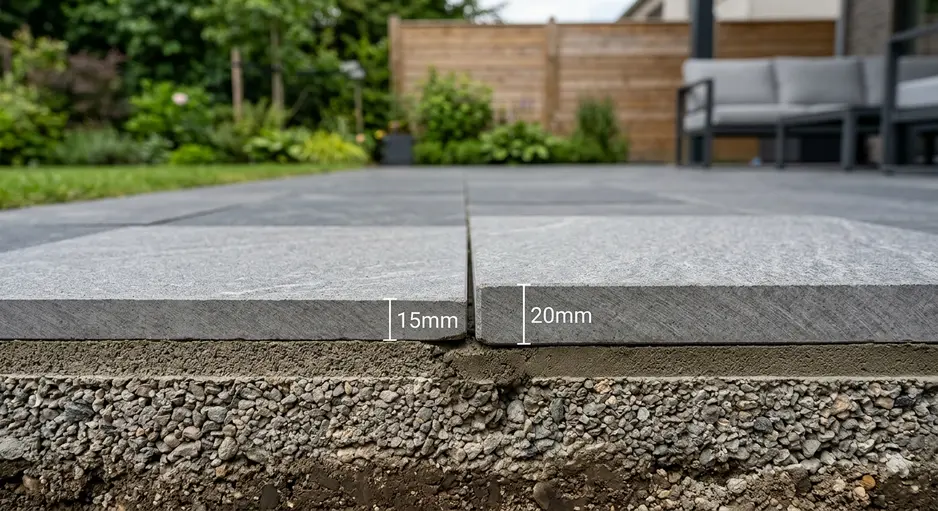
Choosing between 15 mm and 20 mm porcelain is not just a matter of picking the thicker tile. Fifteen-millimetre tiles are lighter and often cost less, while 20 mm porcelain paving slabs support more installation methods and usually handle higher loads.
The best option depends on foot or vehicle traffic, tile size, climate, drainage, substrate quality and installation method. Product test results also matter. For reliable outdoor paving, the tile and the complete installation assembly must work together.
This guide compares 15 mm vs 20 mm thick tiles for patios, terraces, raised floors, commercial landscapes and selected driveway projects.
Is 15 mm or 20 mm Better for Outdoor Paving?
The short answer
15 mm porcelain can be a practical choice for residential patios and terraces when it is fully supported by a suitable concrete base. 20 mm porcelain is generally better for dry laying, pedestal systems and heavier use. For driveways, use only products and installation systems approved for vehicle traffic.
Thickness is only one part of performance
It is easy to assume that thicker porcelain is always stronger. In practice, two products of the same thickness may perform differently. The quality of the porcelain body, tile dimensions, production process and support conditions can change the result.
Before selecting outdoor paving tiles, review:
- Breaking strength and flexural strength
- Tile size and required support spacing
- Water absorption and frost test results
- Point load and impact resistance
- Slip resistance for the intended setting
- Approved installation methods
- Suitability for pedestrian or vehicular traffic
Do not rely on a fixed claim that 20 mm tiles are a certain percentage stronger than 15 mm thick tiles. Ask for product-specific test data, including results based on ISO 10545-4 or an applicable local standard.
15 mm vs 20 mm Outdoor Tile Comparison
Typical applications
15 mm: Bonded patios, balconies, terraces and other pedestrian areas.
20 mm: Patios, pool surrounds, plazas, rooftops, paths and approved driveway systems.
Weight and handling
15 mm: Lighter and often easier to move, cut and place.
20 mm: Heavier and may need two-person handling in large formats.
Installation options
15 mm: Usually best in a bonded assembly with continuous support.
20 mm: May be bonded or installed over sand, gravel or pedestals when approved.
Load capacity
15 mm: Suitable for many residential areas when fully supported.
20 mm: Generally offers higher load-bearing capacity, subject to testing and correct support.
Cost
15 mm: Often has a lower material and freight cost.
20 mm: Usually costs more but offers greater installation flexibility.
Load-bearing capacity and point loads
A distributed load spreads weight over a wide surface. Foot traffic is a common example. A point load places weight on a small area, such as the leg of an outdoor kitchen, a heavy planter, a trolley wheel or the corner of a pedestal.
Point load resistance is important because even heavy-duty outdoor tiles can fail at unsupported edges or corners. A thicker slab may offer more protection, but correct support remains essential.
Breaking strength and flexural strength
Breaking strength measures the force needed to break a tile under test conditions. Flexural strength describes how well the material resists bending stress. Both are useful, but neither should be viewed without considering tile dimensions and installation.
A large slab can react differently from a smaller tile made from the same material. Request test reports and check that the tested format matches the product you plan to buy.
How Installation Changes the Right Thickness
Bonded installation over concrete
Both 15 mm and 20 mm thick tiles may be bonded to a properly prepared concrete slab. The base must be stable, clean, adequately cured and built with the correct slope. It should also be free from defects that could affect the finished paving.
Use exterior-rated adhesives and follow the tile and adhesive manufacturers’ instructions. Full mortar coverage is important outdoors because hidden voids can collect water and create weak points. Back-buttering may help improve coverage where the approved installation method calls for it.
A thicker tile will not correct a cracked base, poor waterproofing or inadequate drainage. Movement joints must also be planned at perimeters, structural joints and required intervals.
Installation over sand or gravel
Installation over sand or gravel is commonly linked with 20 mm porcelain paving slabs. The base must be stable, well compacted, level and able to drain. Edge restraints help prevent the paving from shifting sideways.
Not every 20 mm product is approved for dry laying. Follow the specified bedding depth, joint width and base preparation. Uneven gravel can leave corners unsupported and increase the risk of movement or cracking.
Pedestal installation systems
Pedestals are often used on raised terraces, balconies, rooftops and pool areas. They create space below the paving for drainage, waterproofing layers and concealed services. Individual slabs can also be lifted when access is needed.
Support spacing must match the slab size and tested system. Large slabs may need centre supports or extra support along their edges. Perimeter restraint, wind uplift and fall protection also require careful planning.
A nominal thickness of 20 mm does not prove that a slab is safe for pedestals. The porcelain and pedestal system should be approved as a complete assembly.
Can 15 mm tiles be installed on pedestals?
Only use 15 mm outdoor paving tiles on pedestals when the tile manufacturer and pedestal provider approve the exact format, support layout and expected load. Without that approval, a fully supported bonded installation is usually the more conservative choice.
Best Thickness for Patios, Terraces and Driveways
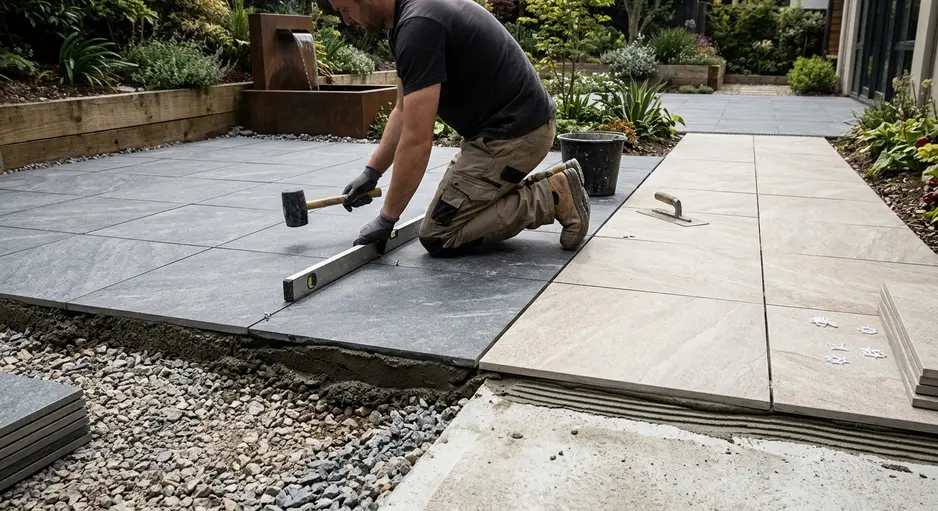
15 mm tiles for terraces and residential patios
15 mm porcelain is well suited to pedestrian areas with a stable concrete base. It may also help where finished floor height or structural weight is limited.
Common uses include:
- Bonded residential patios
- Balconies and terraces
- Pedestrian-only garden areas
- Renovations with height limits
- Outdoor floors with continuous substrate support
For example, a residential terrace over a sound, sloped concrete slab may perform well with 15 mm porcelain. The selected tile must still have suitable slip, frost and strength test results.
20 mm tiles for patios and commercial landscapes
20 mm paving is useful when a project needs more installation choices or greater point load resistance. It is often considered for hospitality areas, plazas, walkways, pool surrounds, rooftop terraces and dry-laid garden paths.
These products can serve both residential and commercial landscaping applications. However, busy public spaces need more than a thick slab. Designers must account for accessibility, expected traffic, maintenance, drainage and local safety rules.
Are 20 mm tiles suitable for driveways?
Some 20 mm tiles for driveways are suitable when the product and full assembly are approved for vehicular use. A bonded installation over an engineered reinforced concrete slab is often required.
Vehicle weight is not the only concern. Turning wheels create extra stress, especially near joints and edges. Delivery vehicles may also be much heavier than passenger cars. Loose gravel, standard sand beds and ordinary pedestal systems should not be used unless they are designed for those loads.
Commercial and high-load areas
Forklifts, service vehicles and heavy equipment require project-specific design. Consult a structural or civil engineer, landscape architect, tile manufacturer and installation-system supplier before work begins.
Weather Durability, Drainage and Safety
Frost resistance and water absorption
Porcelain generally has a low water absorption rate. ISO 10545-3 provides a recognised method for testing water absorption, while ISO 10545-12 addresses frost resistance.
Low absorption is helpful, but it does not guarantee freeze-thaw performance on its own. Confirm that the product is declared suitable for exterior use and for the local climate. Proper installation must prevent trapped water beneath the paving.
Slip resistance ratings
Slip resistance matters around pools, on ramps, at entrances and in any area exposed to rain. EN 16165 and ANSI A326.3 are among the standards used in different markets to assess slip performance.
There is no single rating that suits every setting. Surface texture, slope, footwear, cleaning methods and contamination can all change slip risk. Check the test method and intended use rather than comparing ratings from unrelated systems.
Outdoor drainage and slope
Plan a suitable fall away from buildings and toward approved drainage points. Standing water can lead to staining, slippery surfaces and freeze-related damage. It can also affect bedding layers in dry-laid systems.
Coordinate the tile work with waterproofing, drains and thresholds. Local building codes and system instructions should determine the final outdoor drainage and slope requirements.
Temperature changes and movement
Outdoor surfaces expand and contract with direct sun, frost and daily temperature changes. Include movement joints at perimeters, transitions and specified intervals. Never cover a structural joint with rigid tile or grout.
Cost, Handling and Long-Term Maintenance
Compare total installed cost
15 mm tiles may have a lower purchase price and transport weight. By contrast, 20 mm paving may cost more per square metre and take longer to cut. Large pieces can also require extra handling.
Material price alone does not show the full cost. Review:
- Tile, freight and site handling
- Concrete and substrate preparation
- Adhesive, grout or bedding material
- Pedestals and support accessories
- Waterproofing and drainage
- Cutting and edge finishing
- Movement joints and edge restraints
- Future access and replacement needs
Dry-laid and pedestal systems may reduce adhesive use and allow easier access to services. Bonded work may require more base preparation but can provide firm, continuous support.
Edge chipping and impact resistance
Thicker porcelain provides more material at the edge, but it can still chip if handled poorly. Use suitable wet-cutting tools and approved blades. Do not strike corners or place slabs on uneven ground.
Ordering spare tiles from the same production batch can make future repairs easier and improve colour consistency.
How to Choose Tile Thickness for Outdoor Areas
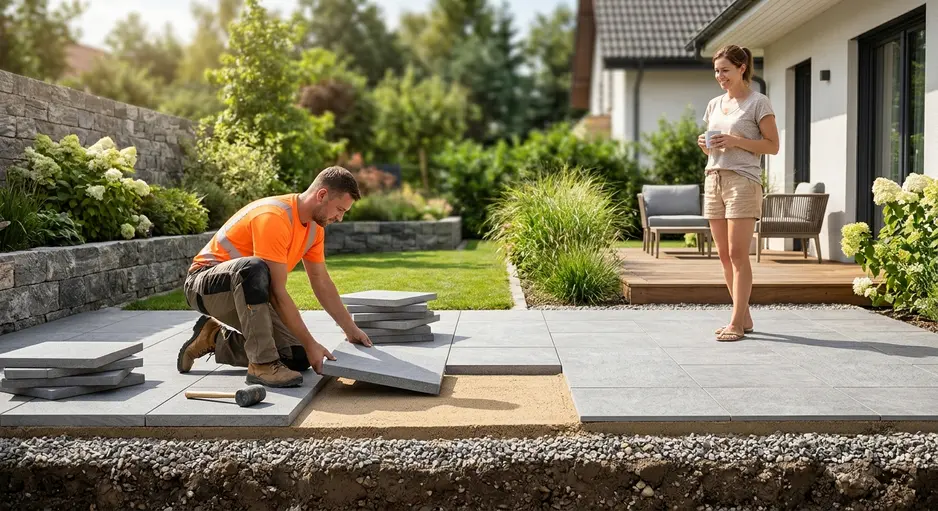
1. Define the expected traffic
Start by deciding whether the area will carry pedestrians, residential furniture, heavy planters, commercial foot traffic, cars or service vehicles.
2. Choose the installation system
Select a bonded concrete installation, dry lay over sand or gravel, raised pedestal system or engineered vehicular assembly. This decision often determines which thickness is practical.
3. Review the technical data
Ask the manufacturer or 20 mm paving tiles supplier for:
- Actual thickness and dimensional tolerances
- ISO 10545-3 water absorption results
- Breaking and flexural strength data
- Frost and slip resistance results
- Support spacing requirements
- Approved installation methods
- Vehicle-use approval, if needed
- Warranty terms and limitations
4. Check samples and site conditions
View samples in natural light and test how the surface feels when wet. Confirm the batch, calibre and edge finish. Measure doors, drains, thresholds and finished floor levels before ordering.
As a general guide, choose 15 mm porcelain for well-supported residential areas with bonded installation. Choose 20 mm paving for dry laying, approved raised systems and projects that need more flexibility. Review Skyiouch Ceramic’s available outdoor porcelain options and request technical specifications before making a final selection.
15 mm vs 20 mm Thick Tiles for Outdoor Paving
Choose the Complete Paving System, Not Thickness Alone
The choice between 15 mm vs 20 mm thick tiles depends on more than size. Use 15 mm porcelain for suitable, fully supported patios and terraces. Consider 20 mm paving for approved dry-laid or pedestal systems and higher-load settings.
Driveways need tested products and engineered assemblies. Before ordering, explore Skytouch Ceramic’s outdoor porcelain range and request the relevant technical data, samples, packaging details and installation guidance for your project.
Frequently Asked Questions
1. Can 15 mm thick tiles be used outdoors?
Yes. They must be rated for exterior use and installed on a suitable substrate. Check their water absorption, frost resistance, slip performance and breaking strength. Fifteen-millimetre tiles are generally better suited to fully supported bonded installations than unsupported dry-lay systems.
2. Are 20 mm porcelain tiles strong enough for a driveway?
Some are, but thickness alone is not enough. The product must be approved for vehicles and installed over an appropriate engineered base. Wheel loads, turning forces, drainage, edge restraint and mortar coverage must all be considered.
3. Can 20 mm porcelain paving be laid on gravel?
Many 20 mm products can be laid over a properly prepared gravel base. Follow the manufacturer’s instructions for compaction, levelling, drainage and edge restraint. Loose or uneven gravel may cause movement and leave slab corners unsupported.
4. Do thicker outdoor tiles crack less easily?
They often provide greater load and impact capacity when other properties are equal. However, cracking can still result from substrate movement, mortar voids, poor support, trapped water or thermal expansion.
5. Is 20 mm porcelain suitable for pedestal systems?
It is commonly used with pedestals, but slab size, support spacing, centre supports and perimeter restraint must be checked. Follow the specifications issued by both the porcelain manufacturer and pedestal-system supplier.